HIPAA-Compliant AI for Healthcare: Automating Patient Scheduling Without the Risk
The Scheduling Gap in Healthcare
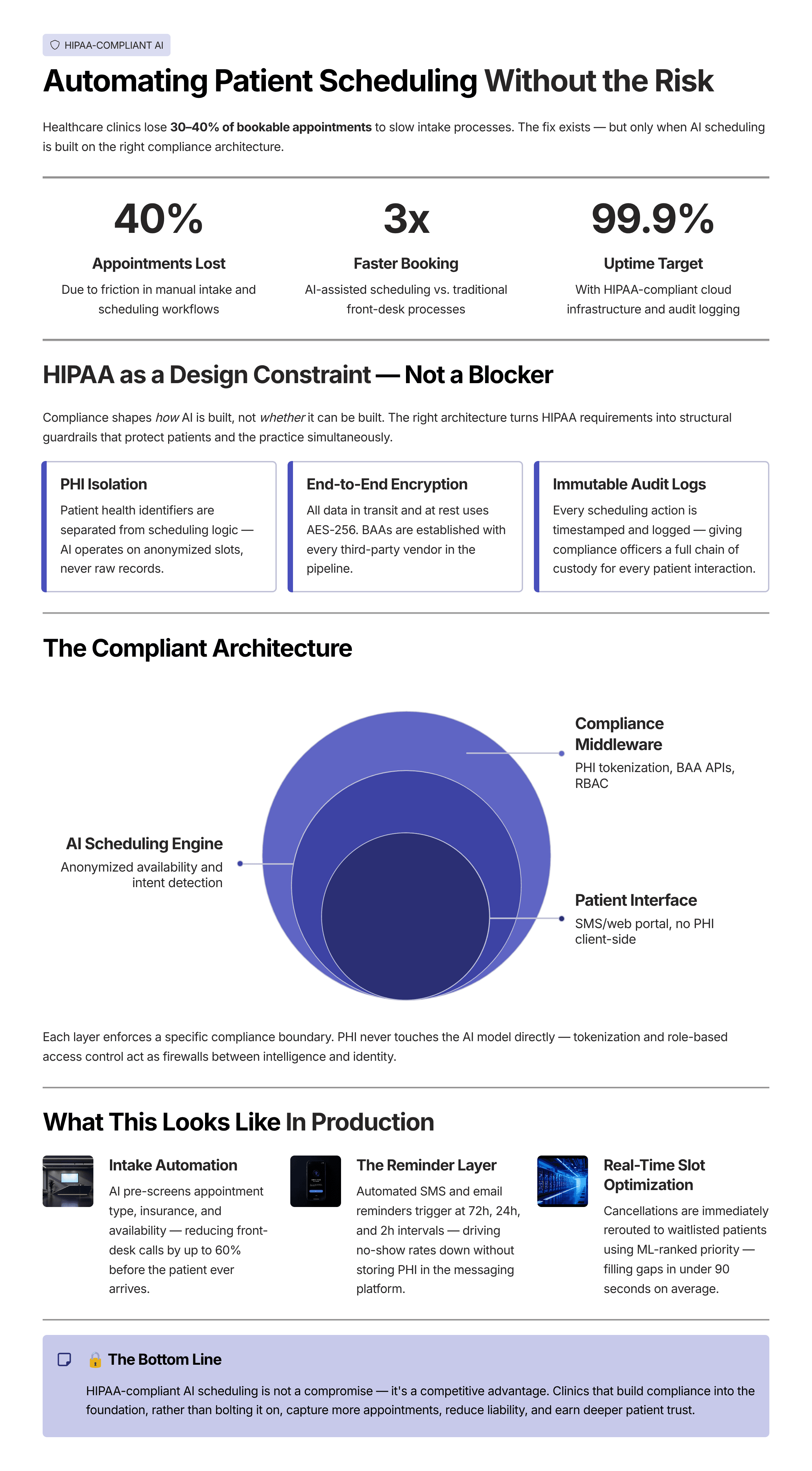
The average healthcare practice loses 15-20 patients per week to slow intake response. Patients submit an inquiry online and wait hours — or days — for a callback. In that window, they book elsewhere. AI scheduling systems respond in seconds, qualify the clinical need, and book the appointment autonomously — without storing PHI in unsecured systems.
HIPAA as a System Design constraint, Not a Blocker
Most AI tools claim HIPAA compliance. Few actually document their architecture in a way that satisfies a BAA (Business Associate Agreement) requirement. Before building any AI system that touches patient data, establish the architecture constraints:
- PHI must not be stored in third-party AI model logs (OpenAI's API is BAA-eligible — their browser-based products are not)
- Data must be encrypted in transit (TLS 1.2+) and at rest (AES-256)
- Audit logs must be maintained for all access to PHI
- Data minimisation: the AI should only receive the minimum information it needs to perform its function
The Compliant Architecture
A HIPAA-compliant AI scheduling workflow routes PHI through your existing EHR system — not through the AI layer. The AI handles the communication orchestration; your EHR handles the PHI storage. Here's how it works:
- Patient submits intake form (no PHI beyond name, contact, appointment type)
- AI classifies appointment type and urgency
- AI checks available slots via EHR API
- AI sends booking confirmation via SMS/email (non-PHI)
- Clinical details entered by patient within your EHR's own secure portal
What This Looks Like in Production
A practice implementing this system saw intake-to-booked rate increase from 54% to 89% within 60 days. The AI handled 73% of scheduling requests autonomously — only routing complex cases (multi-specialist coordination, urgent triage) to admin staff. Admin hours on scheduling dropped by 18 hours/week.
The Reminder Layer
No-show rates average 18-23% in US healthcare. An AI reminder system (SMS 48hr + 2hr before, with easy reschedule link) reduces no-shows by 40-60%. That alone recovers revenue equal to the implementation cost within the first quarter.
Implementation Timeline
A complete AI scheduling implementation for a single-specialty clinic takes 3-4 weeks: 1 week for EHR API mapping and compliance documentation, 1 week for workflow build, 1 week for testing with synthetic data, 1 week for staff training and live monitoring.