The AI Client Onboarding System That Cuts Time-to-Value by 60%
Why Onboarding Is a Revenue Problem, Not a Support Problem
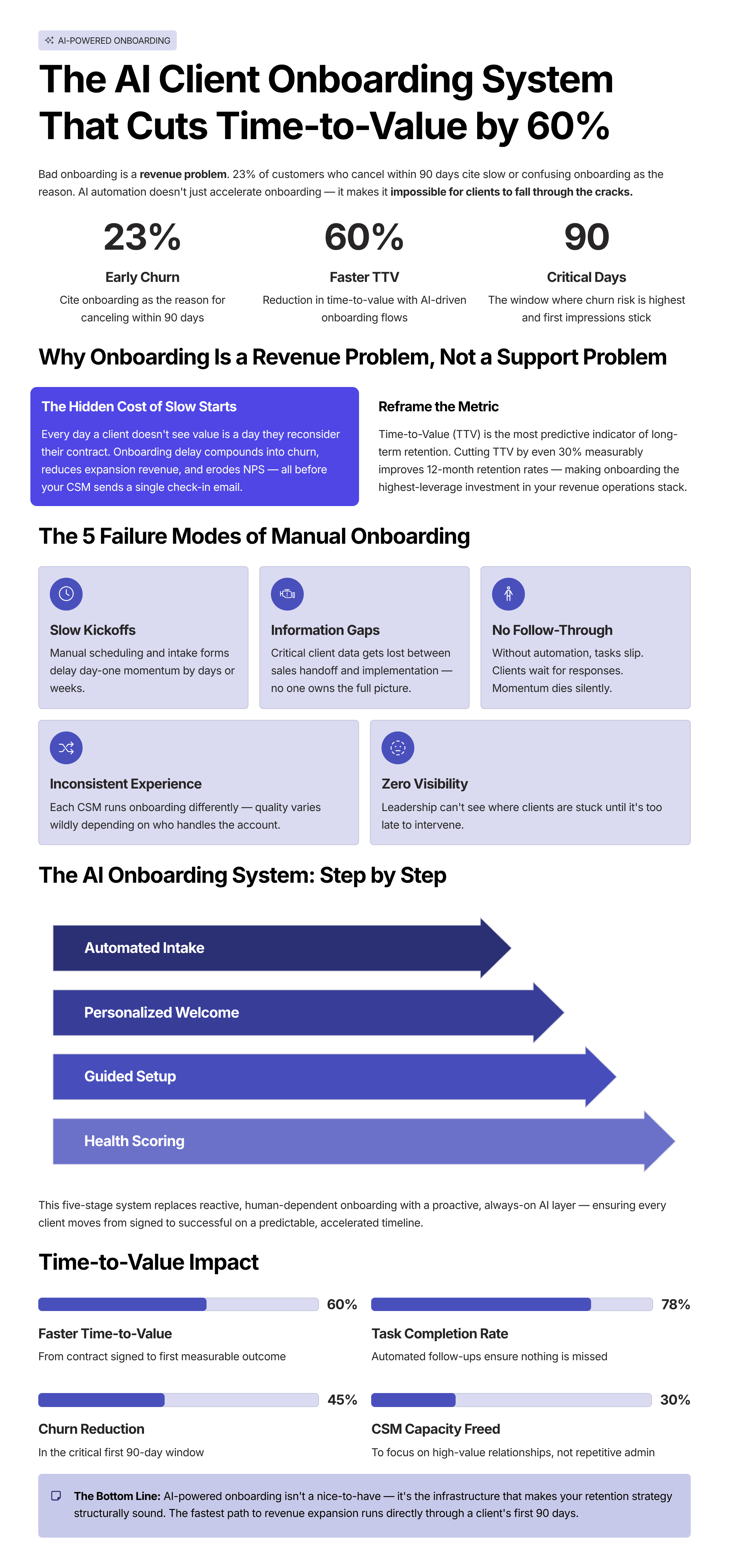
Client onboarding sits at the exact intersection of acquisition and retention. Get it wrong, and you've paid to acquire a customer who churns in 90 days. Get it right, and you accelerate time-to-value, increase expansion revenue probability, and drive referrals. Most B2B companies treat onboarding as a support function. The companies with the highest NPS treat it as a revenue systems problem.
The 5 Failure Modes of Manual Onboarding
- Contract signed → no welcome email for 24+ hours (momentum dies)
- Setup tasks never communicated or tracked
- Week 2 check-in forgotten because CSM is managing 40 accounts
- Customer health score not updated until QBR — 90 days too late
- Escalation only happens after the customer complains
Every one of these is a systems failure, not a people failure. The right automation makes all five structurally impossible.
The AI Onboarding System: Step by Step
Trigger: Contract Signed
When a deal moves to "Closed Won" in your CRM, the onboarding workflow fires automatically: welcome email from the CEO or founder (personalised with account name and primary use case), Slack notification to the assigned CSM, and a HubSpot task created with the first 5 setup milestones.
Milestone Tracking
Each milestone has a deadline and an automated reminder — both to the client and the CSM. A client who hasn't completed their integration setup by day 5 gets an automated email with a 1-click support link and a personal note from their CSM. The CSM gets a Slack alert. Nothing slips through.
Health Score Monitoring
From day 1, the system tracks: login frequency, feature activation, integration completeness, and response rates to check-in emails. A health score below 60 at any point in the first 90 days triggers an escalation to the CSM lead — not the standard CSM. Early problems get senior attention.
Automated Check-Ins
Week 1, 2, and 4 automated check-ins are sent from the assigned CSM's email address (via Gmail API integration). They're personalised to what the client has and hasn't done. A client who hasn't activated Feature X gets a specific nudge about it — not a generic "how's it going" email.
Time-to-Value Impact
The metric that matters most in the first 90 days is "time to first value realisation" — the moment the client does something in your product that directly ties to their stated goal. Automated onboarding systems reduce this metric by 40-60% because the guidance is proactive rather than reactive.